
Villamartín: From Golf Course to Community
Discover how a golf course opened in 1972 transformed Villamartín into one of the most popular residential areas of Orihuela Costa. A story of golf, growth, and international living.
Michal Wykowski
7/1/20264 min read
Villamartín – The Golf Course That Became a Residential Urbanisation
When people think of Orihuela Costa, they often picture beaches such as La Zenia, Playa Flamenca, Cabo Roig, or Campoamor. Villamartín is different. Unlike the coastal urbanisations that grew around the Mediterranean shoreline, Villamartín was born around a golf course. In many ways, it is one of the most successful examples in Spain of how a sporting project transformed an empty landscape into a thriving international community.
Before Villamartín
Until the early 1970s, the area that is now Villamartín was largely rural land belonging to the municipality of Orihuela. The coastline of what we now call Orihuela Costa remained relatively undeveloped compared with other parts of Spain’s Mediterranean coast. Agriculture dominated the landscape, and there were very few residential developments.
Everything changed when developers recognised the potential of the region’s exceptional climate, beautiful scenery, and growing popularity among Northern European visitors looking for sunshine throughout the year.
The Birth of Villamartín
The story of Villamartín begins in 1972 with the construction of the famous golf course that still defines the area today. Designed by renowned golf architect John (Paul) Putman, the course was among the first major golf developments in the southern Costa Blanca. At a time when golf tourism in Spain was still in its infancy, the project was considered visionary.
Unlike many modern developments where houses are built first and amenities follow later, Villamartín was created around the golf experience. The course became the anchor attraction, and residential properties gradually appeared around it. This model attracted buyers from the United Kingdom, Germany, Scandinavia, Belgium, and the Netherlands, who were looking for second homes in the sun.
Where Does the Name “Villamartín” Come From?
The exact origin of the name Villamartín is not well documented in publicly available historical records. The word itself combines the Spanish words villa (town, estate, or settlement) and Martín, one of the most common Spanish surnames and given names. While several theories exist, no definitive historical source confirms whether the name refers to a landowner, developer, or another historical figure connected with the area.
What is certain is that the name became internationally recognised through the golf course long before the surrounding residential community achieved its current size. Today, for many visitors, Villamartín means both the golf course and the urbanisation that grew around it.
Golf Put Villamartín on the International Map
Villamartín Golf quickly earned a reputation as one of Spain’s finest courses. Its mature vegetation, natural terrain, and strategic design made it stand out from many newer resort courses. Over the decades, some of golf’s greatest names have played here, including Seve Ballesteros, José María Olazábal, Ian Woosnam, and Sam Torrance.
The course reached international prominence in 1994 when it hosted the Mediterranean Open, won by Spanish golfing legend José María Olazábal. This event firmly established Villamartín as a championship venue and helped attract golf tourism from across Europe.
Interestingly, many people who originally visited for a golf holiday later returned to purchase properties in the area. Golf was not simply an attraction—it became the engine of urban growth.
From Golf Resort to International Community
What began as a golf development gradually evolved into a complete residential destination. During the 1980s, 1990s, and especially the property boom of the early 2000s, Villamartín expanded rapidly.
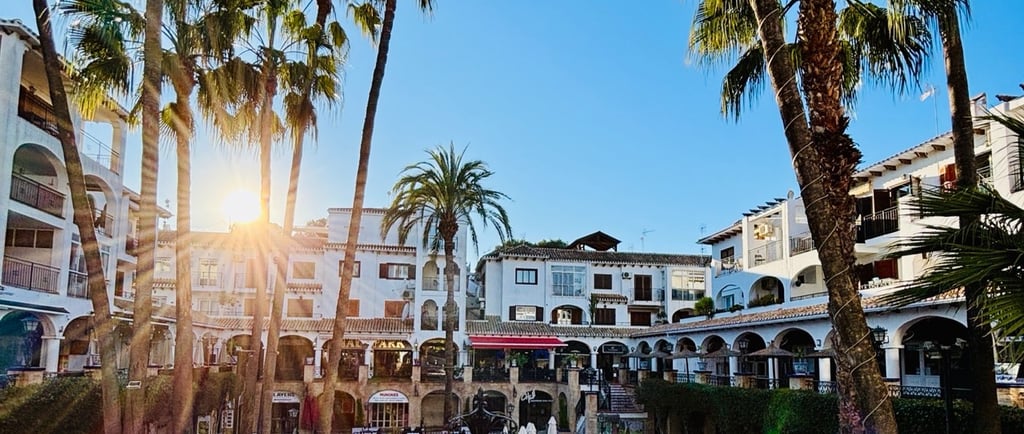
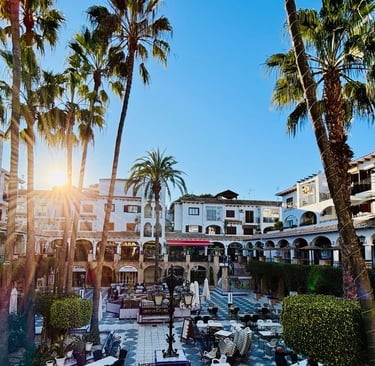
Neighbourhoods such as Villacosta, Montegolf, Eagles Nest, El Galán, Blue Lagoon, Los Dolses, and Las Filipinas developed around the original golf course. Restaurants, shops, medical centres, schools, and leisure facilities followed. The famous Villamartín Plaza became the social heart of the community, offering a unique Mediterranean atmosphere where residents and visitors gather throughout the year.
Unlike traditional Spanish towns that evolved over centuries, Villamartín was intentionally planned as an international residential community. This explains why English is heard almost as often as Spanish and why the area has such a cosmopolitan feel.
Villamartín Today
More than fifty years after the first fairways were created, Villamartín has become one of the most desirable residential areas in southern Alicante Province. What was once a golf resort is now a year-round community that attracts permanent residents, remote workers, retirees, families, and holidaymakers from across Europe.
Golf remains at the centre of its identity, but today Villamartín offers much more:
A championship golf course with over five decades of history.
Easy access to the beaches of La Zenia, Cabo Roig, and Playa Flamenca.
An international community with residents from dozens of countries.
Restaurants, cafés, and entertainment centred around Villamartín Plaza.
Proximity to some of Costa Blanca’s best golf courses, including Campoamor, Las Ramblas, and Las Colinas.
A Legacy Built on Vision
Many places along the Costa Blanca grew because people wanted to live near the sea. Villamartín grew because people wanted to play golf.
What started in 1972 as an ambitious sporting project became one of the most successful residential communities on the Costa Blanca. Its story is proof that a single vision—a world-class golf course surrounded by sunshine and Mediterranean landscapes—can create not just a destination, but an entire town.
Today, Villamartín stands as one of the defining success stories of Orihuela Costa: a place where sport, lifestyle, and international living came together to create a community unlike any other in the region.